
What Do Farm Restrooms Need to Meet OSHA Rules?
Agricultural operations answer to a different rule than a construction site. OSHA portable toilet requirements explain how 1928.110 covers field sanitation for hand-labor employees, and it sets the bar at one facility per 20 workers, reachable within a quarter mile walk from wherever people are working. That walking distance matters more on a farm than almost anywhere else, because crews spread out across acreage instead of clustering around one building. A packing shed at one end of a property and a picking crew a half mile out need two separate setups, not one unit in the middle hoping to split the difference.
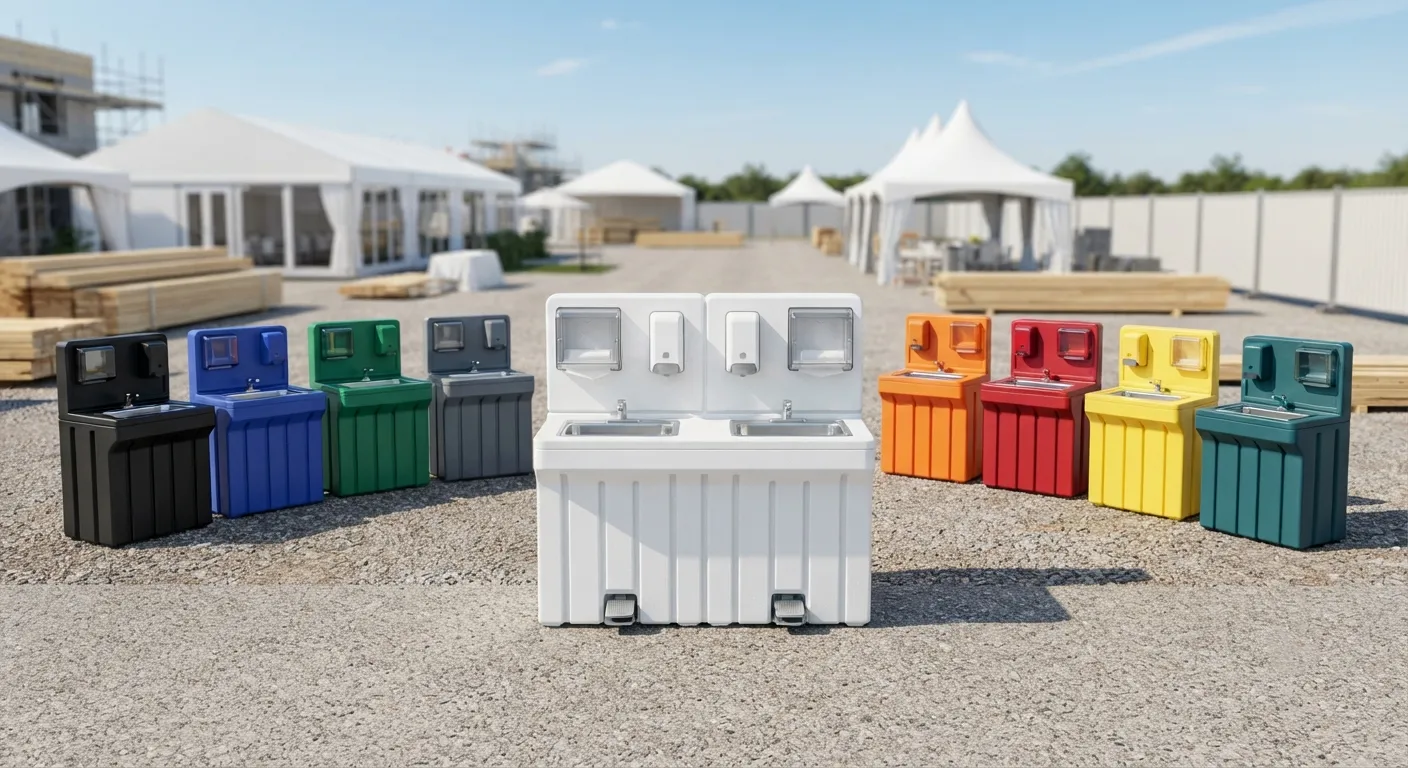
Water counts too. OSHA 1926.51(a)(1) requires an adequate supply of potable water at any place of employment, and that pairs with 29 CFR 1910.141(d)(2), which calls for soap and towels or a hand-drying device at any washing station. Hand sanitizer alone does not satisfy that rule. A handwashing station rental solves both halves at once, and a portable sink rental works well near packing lines where produce handling makes clean hands part of the job, not an afterthought.
Placement matters as much as the count. Our porta potty placement guide walks through solid ground, wind direction and service truck access, all of which look different on a farm than on a job site. If you are still working out numbers, how many porta potties do I need breaks it down by crew size and shift length.
How Many Units Does a Farm Crew Need?
Crew size drives the count, and OSHA 1926.51(c) sets the construction-adjacent standard most rental companies use as a baseline: one toilet for 20 workers or fewer, then one toilet seat and one urinal per 40 workers as crews grow past that. A 15-person picking crew in Paradise needs one standard porta potty rental, or a porta john rental if that is the term you know it by; a 45-person harvest crew needs two units minimum, spread across the work area rather than parked side by side, and crews wanting extra comfort can look at a deluxe flushable porta potty.
Seasonal spikes change the math fast. A farm that runs lean most of the year and doubles its crew for a six-week harvest should plan rentals around that curve, not a flat number. Monthly terms make sense for the long stretch, and a look at monthly porta potty rental pricing shows how the per-day cost drops the longer the unit stays. For the short, intense push, a porta potty rental per day breakdown fits better.
| unit | duration | low | typical | high |
|---|---|---|---|---|
| standard | day | 100 | 150 | 350 |
| standard | week | 130 | 200 | 500 |
| standard | month | 125 | 200 | 325 |
Larger operations running packing sheds or processing lines sometimes need more than toilets. A roll-off dumpster rental handles crop waste and packaging debris, a 10 yard dumpster rental fits smaller cleanup jobs, and a temporary fence rental keeps equipment yards secured between shifts. Crews with ADA obligations on site should also review ADA restroom requirements or book an ADA accessible porta potty directly.
Can a Farm Get Restrooms Set Up Fast for Harvest Season?
Yes. Harvest timing does not wait on paperwork, and neither do we. Delivery scheduling in Paradise, NV typically moves within days once a crew size and site address are confirmed, and our emergency porta potty rental option covers last-minute harvest starts; Winchester sits 5.6 miles north of Paradise if a second property needs coverage on the same run, and our service areas page lists the full delivery footprint. Whitney, 6.7 miles east, and Enterprise, 11.6 miles southwest, fall inside the same delivery radius for growers running land in more than one direction.
Farms with rough or unpaved access should flag that when booking. A roll-off delivery needs about 60 feet of straight clearance behind the truck, and a similar clearance helps porta potty trucks maneuver around irrigation lines, fencing or parked equipment. If a spray operation is part of the work, know that OSHA 1926.51(f)(1) requires washing facilities specifically where employees apply pesticides, herbicides or other harmful contaminants, which is a narrower rule than general handwashing and worth planning for separately.
For operations that need a break from portable units entirely, a restroom trailer rental or a 2 stall restroom trailer gives packing house staff and office crews a nicer setup, a storage container rental keeps tools and supplies secure between shifts, and a mobile office trailer rental rounds out a harvest headquarters. Full pricing detail lives on the porta potty rental cost page, and general questions belong on the frequently asked questions page.
How often do farm porta potties get serviced?
ANSI/PSAI Z4.3 sets the baseline at once a week for up to 10 users over a 40-hour week, but busy harvest crews often need twice-weekly visits. We adjust the schedule to crew size once the season ramps up.
Do farm workers count differently than construction workers under OSHA?
Yes. OSHA 1928.110 covers agricultural field sanitation separately from the construction standard in 1926.51(c), with its own quarter-mile walking distance rule for reaching a facility.
What size unit works best for remote fields?
A standard unit is the most common choice: about 44 by 48 inches on the ground and 92 inches tall, with a 60 to 70 gallon holding tank that handles a full week between services for a small crew.
Can restrooms move as the crew moves across a property?
Yes. Units relocate between fields as harvest progresses. Flag rough terrain or long tow distances when booking so the truck route gets planned in advance.
Does a hand sanitizer station meet OSHA's washing requirement?
No. 29 CFR 1910.141(d)(2) calls for soap and towels or a hand-drying device. A hand sanitizer station rental supplements that but does not replace it on its own.
Next step
Get a delivery date
Tell us the address, the dates and the headcount. We size the order and confirm the route.